From Christie's description (catalog page): "With Indra astride his white elephant Airavata at center, Jayanta next to him in a horse-drawn chariot and both facing Krishna and Satyaki seated on golden Garuda, with Jayanta shown again above engaged in fierce battle with Pradyumna at upper right, the celestial inhabitants in their cloud-borne palaces at left looking on."
From the Library site: With Ravana finally dead, Sita has prepared herself for seeing her husband once again. But Rama has repudiated her: she has lived in another man's house and hence it would not be fitting for him to take her back. To prove her chastity and vindicate her honour, Sita has a great fire prepared and casts herself into it. Agni the golden god of fire himself rises from the flames attesting to Sita's purity and presents her to her husband. The gods headed by Brahma on his goose, Indra on his elephant and Siva and Parvati on the bull Nandi come down from heaven and Rama's father, king Dasaratha, comes back from the dead all with the same message. Rama announces that he has not doubted her for an instant, but that the trial was necessary so that the people should not doubt her either. He requests that the god Indra restore to life those monkeys who have died in the struggle. As Indra departs, he bathes the dead monkeys in nectar, so that they return, wildly rejoicing, to life.
Details:
The gods Brahma, Shiva, and Indra appear;
Agni restores Sita from the fire;
Rama's father, Dasharatha, appears;
Indra brings monkeys back to life.
Indra on Airavata
painting circa 1820
(from the British Museum)
Here is the description from the British Museum page: Gouache painting on paper from a portfolio of sixty-three paintings of deities and daily life. Indra, guardian of the east, rides on his elephant, Airāvata. The red-complexioned and thousand eyed god is accompanied by two attendants on foot, one carrying a parasol, the other carrying a spear. Indra has a tanka (chisel) in his upper right hand, a vajra (thunderbolt) in his upper left, and in the lower right, a sword with a serrated edge. Airāvata carries a garland of flowers in his trunk.
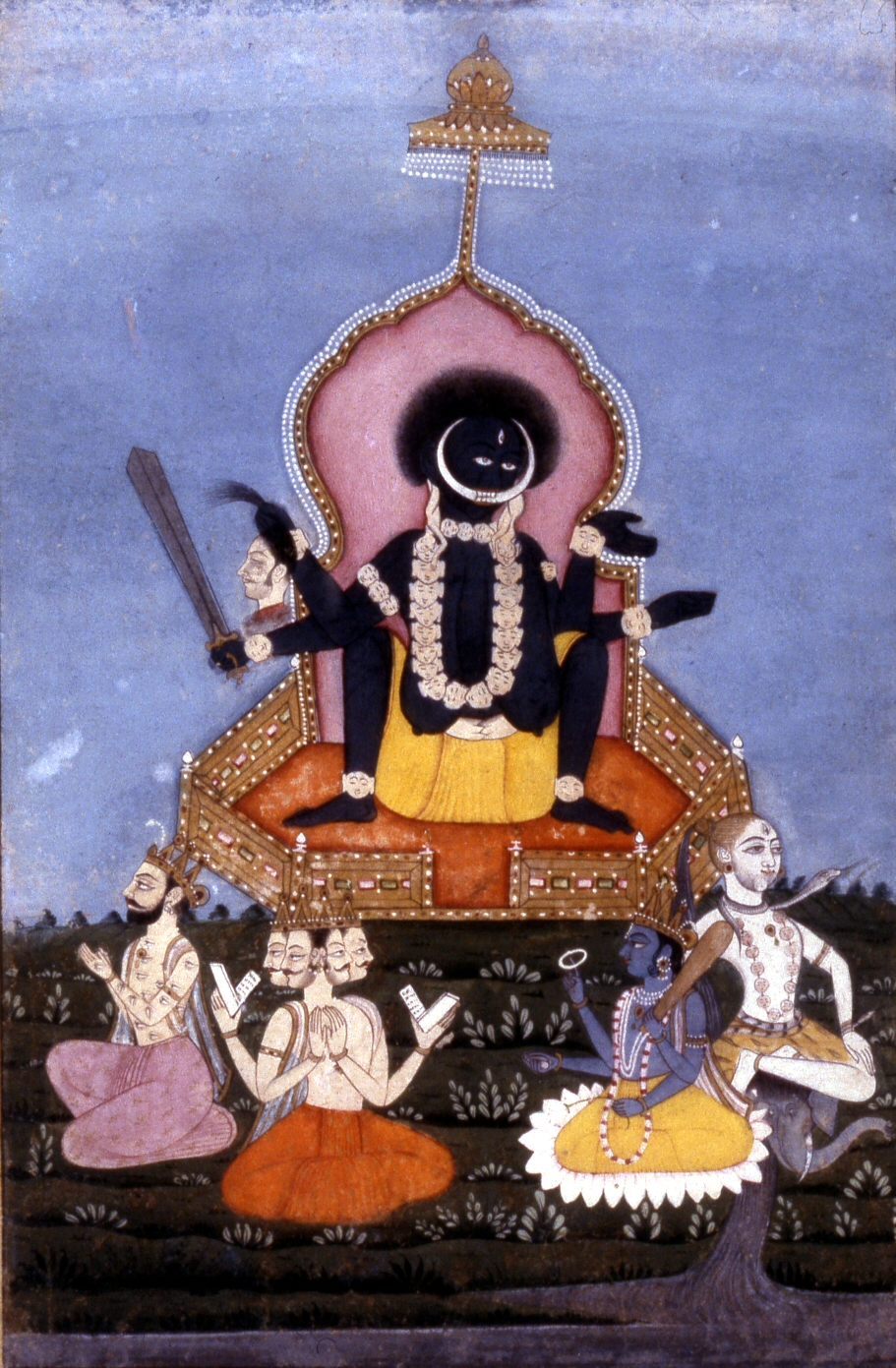
From the Museum site: The terrifying goddess Kali, wearing a necklace of skulls and holding a severed head in one of her hands, is here worshiped by the great gods. From the left, we see Indra, Brahma (the creator), Vishnu (the preserver), and Shiva (the destroyer). Kali stands for the forces of destruction, but she is also a life-giver. Her posture is that of a woman giving birth.