Showing posts with label Images: Brahma. Show all posts

Monday, February 10, 2020

Image: Hayagriva and Brahma


Hayagriva and Brahma


Hayagriva is returning the Vedas to Brahma; you can read more about Hayagriva at Wikipedia.


Wednesday, February 5, 2020

Image: Churning of the Ocean


A 19th-century roundel of the churning of the ocean by the gods and demons, with Vishnu in his Kurma (turtle) avatar.

More about Kurma and Samudramanthan at Wikipedia.


Monday, August 19, 2019

Image: Sita's test by fire


Sita's test by fire
(Wikimedia: British Library's Mewar Ramayana)

From the Library site: With Ravana finally dead, Sita has prepared herself for seeing her husband once again. But Rama has repudiated her: she has lived in another man's house and hence it would not be fitting for him to take her back. To prove her chastity and vindicate her honour, Sita has a great fire prepared and casts herself into it. Agni the golden god of fire himself rises from the flames attesting to Sita's purity and presents her to her husband. The gods headed by Brahma on his goose, Indra on his elephant and Siva and Parvati on the bull Nandi come down from heaven and Rama's father, king Dasaratha, comes back from the dead all with the same message. Rama announces that he has not doubted her for an instant, but that the trial was necessary so that the people should not doubt her either. He requests that the god Indra restore to life those monkeys who have died in the struggle. As Indra departs, he bathes the dead monkeys in nectar, so that they return, wildly rejoicing, to life.

Details:
The gods Brahma, Shiva, and Indra appear;
Agni restores Sita from the fire;
Rama's father, Dasharatha, appears;
Indra brings monkeys back to life.

Details:


Thursday, December 22, 2016

Image: Kurma and Vasuki churning the Ocean


Kurma and Vasuki churning the Ocean
India, Himachal Pradesh, circa 1760
(Image source: Philadelphia Museum of Art)

From the Museum site: The Hindu god Vishnu activates each cycle of existence by creating the universe, together with the devas (gods who uphold cosmic order) and the asuras (anti-gods or demons who disrupt it). Vishnu intervenes in the perpetual struggle by incarnating in earthly forms called avatars, usually standardized as a set of ten. The second of Vishnu’s avatars was the tortoise Kurma (seen here as the circle in the water that supports the pink mountain on which Vishnu sits). When chaos and floods devastated the earth, all good things were lost in an ocean of milk. Kurma dove to the ocean bottom and the devas and asuras joined forces to set the cosmic mountain Meru on his back. Then the serpent king Vasuki wrapped around the mountain as a churning rope. The devas and asuras stood on opposite sides, churning the ocean of milk to release the treasures.

Details:


Thursday, May 19, 2016

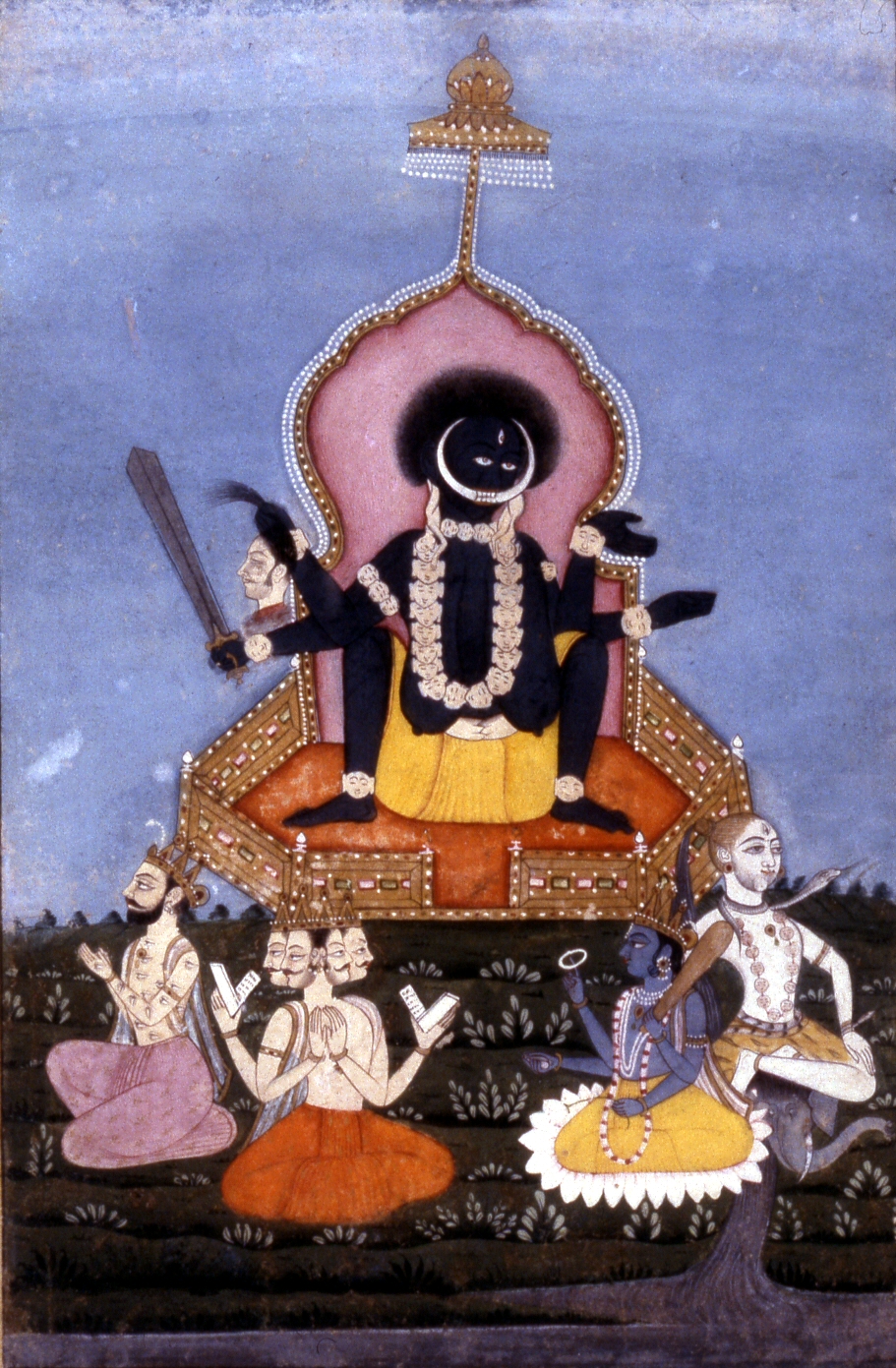
Image: Kali


Kali with Indra, Brahma, Vishnu, and Shiva. 
(Wikimedia: Walters Art Museum page)

You can read more at Wikipedia:
Kali, Indra, Brahma, Vishnu, Shiva.

From the Museum site: The terrifying goddess Kali, wearing a necklace of skulls and holding a severed head in one of her hands, is here worshiped by the great gods. From the left, we see Indra, Brahma (the creator), Vishnu (the preserver), and Shiva (the destroyer). Kali stands for the forces of destruction, but she is also a life-giver. Her posture is that of a woman giving birth.

Details:


Image: Kurma and Vasuki churning the Ocean


Kurma and Vasuki churning the Ocean,
circa 1860
(Victoria and Albert Museum; Wikimedia)

You can read more about the Churning of the Ocean
(Samudra Manthan) at Wikipedia.

Detail:


The gods: Shiva, Vishnu, Brahma


Wednesday, May 18, 2016

Image: Krishna and the Conch


Krishna declaring the end of Mahabharata War
by blowing the Conch Shell,
as the celestials observe from on high

More about Krishna at Wikipedia, and there is also an article about his conch: Panchjanya. You can also read more about the Razmnama.

Image: Brahma


Image: Brahma

More about Brahma at Wikipedia.


Image: Brahma with Vashishtha


Brahma with Vashishtha

You can read more at Wikipedia about Brahma and Vashishtha.

Detail:


Image: Vishnu and Lakshmi on Shesha, with Brahma


Vishnu and Lakshmi on Shesha, with Brahma


You can read more at Wikipedia:
Vishnu, Lakshmi, Shesha, Brahma.

Bhadrakali


Goddess Bhadrakali
worshipped by the three major gods of Hinduism:
Brahma, Vishnu and Shiva.
(17th century; Wikimedia - Freer Gallery of Art)

You can find out more about Bhadrakali at Wikipedia.

Brahma and the Lokapalas


Brahma on a turtle with the four Lokapalas. 

From left to right: Varuna on a horse, Kubera with a lion, Yama with a bull, and Indra with an elephant.

You can read more about the Lokapalas at Wikipedia, and also about Brahma.

(Wikimedia: Sri Lanka, 9th century; the object is in the Metropolitan Museum of Art, but no image at their website.)

Some detailed images: