Showing posts with label Images: Dasharatha. Show all posts

Tuesday, September 3, 2019

Image: Dasharatha and Rama


Dasharatha and Rama
circa 1700

From the Museum site: This painting shows King Dasaratha embracing his son, Rama, who is an incarnation of the Hindu god Vishnu. It is an illustration of a scene from the great Hindu epic, the Ramayana. Rama, depicted blue-skinned, reassures Dasaratha, who was anxious about Rama’s safety after his confrontation with Parasurama, in an episode from the first book of the Ramayana. The three princes on horseback in front of the chariot are Rama's brothers. The painting is part of a series formerly in the ancestral collection of Raja Raghbir Singh of Shangri, descendant of the rulers of Kulu, in the Punjab Hills of northern India.

Detail:


Saturday, August 31, 2019

Image: The death of Dasaratha


The death of Dasaratha
circa 1605
(Image sourceMetropolitan Museum)

From the Museum site: King Dasharatha emerges in the Ramayana as essentially a noble character, though flawed by the weakness that allowed him to be swayed by his second wife Kaikeyi, whose ambitions for her own son caused the king to banish the crown prince Rama for fourteen years. Having succumbed to this pressure, Dasharatha, plagued by regrets, took to his sickbed, where he eventually died of grief. The sorrow of his queens and female attendants is conveyed by their disheveled hair and by the cradling of their cheeks in their hands.


Monday, August 19, 2019

Image: Sita's test by fire


Sita's test by fire
(Wikimedia: British Library's Mewar Ramayana)

From the Library site: With Ravana finally dead, Sita has prepared herself for seeing her husband once again. But Rama has repudiated her: she has lived in another man's house and hence it would not be fitting for him to take her back. To prove her chastity and vindicate her honour, Sita has a great fire prepared and casts herself into it. Agni the golden god of fire himself rises from the flames attesting to Sita's purity and presents her to her husband. The gods headed by Brahma on his goose, Indra on his elephant and Siva and Parvati on the bull Nandi come down from heaven and Rama's father, king Dasaratha, comes back from the dead all with the same message. Rama announces that he has not doubted her for an instant, but that the trial was necessary so that the people should not doubt her either. He requests that the god Indra restore to life those monkeys who have died in the struggle. As Indra departs, he bathes the dead monkeys in nectar, so that they return, wildly rejoicing, to life.

Details:
The gods Brahma, Shiva, and Indra appear;
Agni restores Sita from the fire;
Rama's father, Dasharatha, appears;
Indra brings monkeys back to life.

Details:


Friday, February 16, 2018

Saturday, April 1, 2017

Image: Dasaratha


Dasaratha announces the birth of his four sons
circa 1600

You can find out more about Dasharatha at Wikipedia, and you can see the Freer Ramayana online: volume 1 and volume 2.

Detail:


Monday, January 30, 2017

Image: Dasharatha Ponders Rama's Exile


Dasharatha's Court
Chitrashala Press in Pune

You can read more about Dasharatha and about Kaikeyi and Manthara at Wikipedia.

Detail: Kaikeyi and Manthara


Saturday, January 14, 2017

Image: Rama Goes into Exile


Rama Goes into Exile
Pahari painting; circa 1700
(British Museum)

For more about Dasharatha, see Wikipedia. Details:


More information from the Museum site: Scene from the Ramayana: the departure of Rama, Sita and Lakshmana into exile. Rama, his wife, and brother are all seated on a chariot driven from Ayodhya, and literally beyond the borders of the painting, by two horses. They are accompanied by various individuals wishing them well. King Dasaratha, Rama's father, stands in the left corner with one of his wives (Kaikeyi).

Sunday, January 1, 2017

Image: Kaikeyi Takes Sita's Ornaments


Kaikeyi Takes Sita's Ornaments
Ramayana manuscript, circa 1700

See Wikipedia for more about Kaikeyi's role in the exile of Rama.

Detail:


Tuesday, December 27, 2016

Image: Taking Leave of Dasharatha


Taking Leave of Dasharatha
(British Library: Mewar Ramayana)

From the Library site: At the palace the king's minister Sumantra brings Rama, Laksmana and Sita to the grieving Dasaratha, who had previously ordered Sumantra to summon his queens and all his women. The king tries to persuade Rama not to go to the forest, even to rise up in rebellion and set him aside, but Rama replies that he must obey Kaikeyi's command to go into exile. Kaikeyi who is seated beside Dasaratha is upbraided by Sumantra, but she refuses to change her mind. Unable to speak through grief, Dasaratha tenderly embraces the three children, taking them on his lap, surrounded by his three chief queens and his other wives.

Detail: Rama, Lakshmana, Sita, and Dasharatha


Monday, December 26, 2016

Image: Rama's Chariot Leaves Ayodhya


Rama's Chariot Leaves Ayodhya
(British Library: Mewar Ramayana)

From the Library site: Rama, his wife and brother, dressed in the clothes of bark that Kaikeyi has made them put on, ride off in a chariot driven by Sumantra and surrounded by the townspeople. Dasaratha emerges from his palace and goes through the gate of the city surrounded by his queens. Dasaratha and Kausalya according to Valmiki's text hurry after the chariot until Rama, unable to bear the sight, has to tell Sumantra to quicken his pace so that they would be left behind. The artist Sahib Din has the king simply make a grand gesture of farewell.

Detail: Dasharatha


Detail: Rama, Sita, and Lakshmana


Thursday, December 22, 2016

Image: Dasaratha and the boy's blind parents


Dasaratha and the boy's blind parents
(from the Freer Ramayana)

You can read about the boy Shravana at Wikipedia, and you can also see the Freer Ramayana online: volume 1 and volume 2.

Detail:


Image: Kaikeyi and Dasaratha


Kaikeyi and Dasharatha
17th century
(Image source: British Museum)

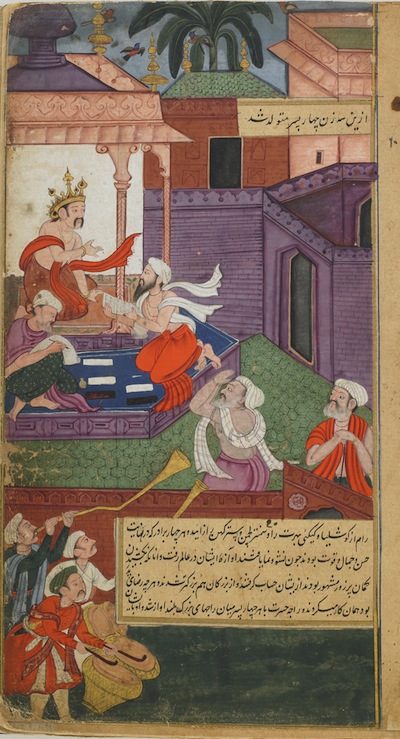
Kaikeyi and Dasaratha, with Dasharatha's minister, Sumantra, in the middle. On the left Kaikeyi mourns and then presents her demands to Dasharatha; on the upper right we see him listening to her demands, and then in the lower left, we see him beseeching her to change her mind.

Detail:


Image: Dasaratha and Vishvamitra


Dasaratha and Vishvamitra
circa 1780
(Image sourceMetropolitan Museum)

From the Museum site: In the central scene, the ascetic sage Vishvamitra asks King Dasaratha if his sons Rama and Lakshmana can help rid him of the demons Marichi and Subahu. After much debate the king agrees, and the brothers are seen with Vishvamitra departing through a gateway (lower right) and in a distant pavilion. This event sets the stage for Rama’s and Lakshmana’s interactions with ascetics in the forest and anticipates their many battles with demons throughout the Ramayana. 

Detail:


Wednesday, August 17, 2016

Image: King Janaka and King Dasaratha


King Janaka Greets King Dasharatha
at His Son Rama's Wedding

circa 1700; Jammu and Kashmir, India
(Philadelphia Museum of Art)

More about Janaka and Dasharatha at Wikipedia.

Detail:


Sunday, December 28, 2014

Image: King Dasaratha


Image source: King Dasaratha, on his way to Rama's wedding

Also at the Metropolitan Museum website,
with notes on the artists and style.

Detail:


Tuesday, July 15, 2014